
When Engagement Cannot Reach the Consequential Decision
The organisational capability behind the Fourth Pillar
In earlier ELSA articles, we argued that projects in shared space need a Fourth Pillar of local legitimacy and support. We then looked at why engagement must start before a project is ready to be explained, and why a project can be strong on paper but weak in place.
Together, those pieces leave a practical question: once something important has been heard, can it reach the people who can still change the project?
When listening does not reach the project
Consider a common situation. A neighbour raises a concern about the position of a turbine. A fisher explains how a proposed cable route may affect fishing activity. The engagement lead listens, records the issue, and passes it on.
But engineering is working to a layout already assumed in the business case. The commercial team is protecting yield. The permitting team is focused on compliance. Senior decision-makers may see the issue only after it appears in an objection, appeal, or campaign.
The person leading the engagement may have done the job well. The project may still be unable to respond.
Calling this simply an engagement problem can be unhelpful. It directs attention towards the skill of the person in the room, when the deeper question may be whether the organisation has given that person a credible route to the decision.
Engagement and decision connection
Engagement is where people meet, exchange knowledge, test assumptions, and build or lose trust. It matters in its own right.
But engagement does not own the project layout, investment case, statutory consent, procurement strategy, or construction programme. If the people doing it cannot reach those who own such decisions, the process has a ceiling.
A project can become good at hearing and reporting without becoming good at learning and changing.
We are using decision connection to describe the practical link between what matters and the decision that can address it. A concern, aspiration, right, or opportunity must reach the right decision owner with enough evidence, authority, and time for a response. The reasoning then needs to travel back to the people affected.
This is a question for project leadership and the whole development team. It is not a new name for an engagement technique.
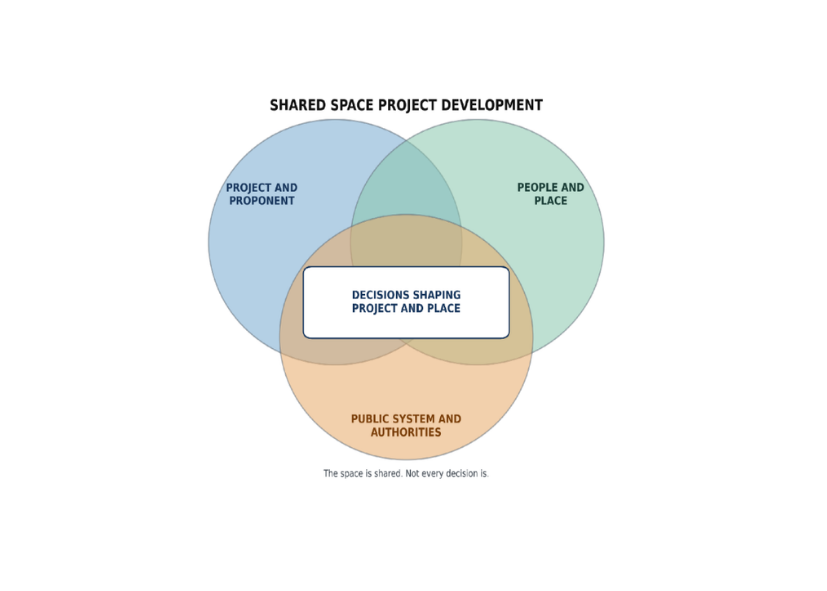
A shared field of consequence with different decision rights
Shared space, different decision rights
The three circles represent the project and its proponent, the people and place affected, and the public system and authorities. For an offshore project, people and place may include coastal communities, fishers, ports, rights-holders, and other users of marine space. They are not always neighbours in the ordinary geographical sense, but the project enters their world.
The centre is deliberately labelled “decisions shaping project and place”. It represents a field of shared consequence and interdependence. The decisions within it are not all governed in the same way.
The space is shared. Decision rights within it may sit with one actor, overlap between several, or be genuinely shared.
Decision ownership means having the legitimate authority and responsibility to make a decision. Across the three circles, several relationships are possible:
-
Some decisions sit legitimately with one actor.
-
Some involve overlapping rights and responsibilities.
-
Some require agreement or consent from another party.
-
Some are genuinely shared.
-
Even where final authority rests with one actor, legitimate influence may need to reach that decision.
A single project may contain all of these. The task is not to move every decision towards shared ownership. It is to identify which relationship legitimately applies, make it explicit, and ensure that what matters can reach the decision while it remains open.
For example, a developer may decide which qualified contractor to appoint, while affected people may legitimately influence the traffic, noise, access, or working-hour requirements that the contractor must meet.
A public authority may have sole responsibility for granting, refusing, or placing conditions on a statutory consent, while evidence from the proponent, affected people, rights-holders, and other public bodies informs that determination.
A landowner or rights-holder may decide whether to grant access, enter an agreement, or provide a form of consent that only they can give.
A community is rarely a single legal decision-owner. However, a community association, trust, co-operative, or other legitimate local body may decide, within its mandate, how community-owned land or buildings are used, which locally led priorities it will pursue, whether to enter a partnership with the project, and how resources under its control are governed. People and groups also retain agency over whether and how they participate, organise, and represent their interests.
Other choices may need to be worked through together. The siting of an onshore wind turbine, the layout of a solar farm, the route to a cable landfall, a fisheries coexistence arrangement, the treatment of a locally valued place, or the design of project-specific mitigation may require co-design, negotiated agreement, or consent, even where one party ultimately retains formal approval.
What matters for engagement to be meaningful is that decision ownership is clear, but not used as a barrier against legitimate influence. The appropriate relationship between ownership and influence cannot be determined by proponent preference alone. It must reflect the rights involved, who is affected and how, the knowledge needed to make a sound decision, and whether the project depends on others for access, consent, cooperation, or long-term coexistence.
The central question is therefore not only, “How much participation can we offer?” It is also:
What is the decision? Who has the authority and responsibility to make it? Who is affected? What rights and knowledge need to be recognised? Which relationship between decision rights applies? What remains genuinely open? And can what we learn still influence the outcome?
Halfway up which ladder
Research by Robi Nilson and colleagues found that renewable energy developers in the United States already use a range of engagement strategies and sometimes adjust project designs in response to community feedback. The study also found that most respondents preferred members of the public to provide input, but not to recommend or make decisions. Drawing on Arnstein’s ladder of citizen participation, the authors described this as being ‘halfway up the ladder’.
One reading is that developers are reluctant to climb higher. Another possibility is that we are seeing the structural ceiling of a particular project-development model.
Choice A – defend the proposition. The project is substantially the answer. Engagement explains it, tests reactions, identifies mitigation, and may improve aspects of the design, but the proposition remains the organising frame.
Choice B – work it through together. The developer arrives with a serious proposition, but the realities of the shared space can influence material decisions while consequential choices remain genuinely open.
These are working hypotheses, not labels for good and bad developers. The same project may use different approaches for different decisions, and many decisions should properly remain with a developer, authority, landowner, community, or rights-holder. However, if the matters affected people consider most consequential are already fixed, more polished engagement cannot remove that ceiling.
We may therefore be looking at more than different positions on one ladder. We may be looking at different decision architectures – each with its own ladder and structural ceiling.
In one architecture, providing input may be close to the top of what the project-development system permits. In another, the appropriate level of influence depends on the decision, its legitimate owner, who is affected, and what remains genuinely open.
Four questions that expose the gap
Take one live concern, aspiration, right, or opportunity, and ask four questions:
-
Materiality. What matters, and to whom?
-
Decision leverage. Which project decision could address it?
-
Authority. Who owns that decision, and whose influence is legitimate?
-
Openness. What remains genuinely open, and until when?
If a project cannot answer these questions, engagement may be active but disconnected from the project-development system.
After the decision, the project should explain what was considered, what was decided, what changed or did not change, and why. This does not promise that every request will be accepted. It does give people a credible route into the decision and an accountable explanation of the outcome.
The review can be used before a project stage gate, when a new local issue emerges, or when a relationship begins to harden. It shifts the conversation from whether the engagement team performed well to whether the project is still capable of responding.
The organisational capability behind the Fourth Pillar
Projects routinely build specialist teams, mandates, controls, and evidence for their technical, financial, and legal pillars. The Fourth Pillar needs comparable organisational attention.
In practice, this means that engagement staff can reach decision owners before conflict escalates; leaders are prepared to meet affected people and sponsor a response; project functions have a way to reconcile local knowledge with technical, environmental, commercial, financial, legal, and permitting considerations; and stage gates show which material local matters have been considered while options remain open. The organisation should also retain what it learns so that the next project does not begin from zero.
Within ELSA, we call this Fourth Pillar Capability: the organisational capability to understand what matters in a shared place, connect that knowledge to consequential project decisions, and reconcile it with technical, financial, and legal requirements so that a project can earn and sustain local legitimacy and support. Engagement remains essential. The capability question is whether the project is organised so that engagement can matter to the decisions shaping project and place.
The three-circle picture helps because it does not make one actor responsible for the whole. The proponent, authorities, and people connected to the place each bring legitimate rights, knowledge, responsibilities, and constraints. Fourth Pillar Capability creates the relationships and decision pathways needed to work through the overlap.
A wider view of project success
If success means only that the original proposition receives consent, the organisation has a strong incentive to defend it. A more useful test is whether the development process identifies a project that can succeed technically, financially, legally, and in the place that will host it.
Sometimes the project will proceed substantially as proposed because the fit is sound. Sometimes it will be reshaped and then proceed. Sometimes the better decision will be a different site, route, scale, technology, or arrangement. In some cases, pausing or withdrawing early will avoid committing more capital and creating more conflict around a proposition that cannot be made workable.
Not every change is an improvement, and withdrawal is not automatically responsible. The value lies in comparing the real options while the cost of change is still manageable. Across a portfolio, it should be possible to examine whether earlier decision connection reduces avoidable redesign, delay, objections, legal costs, and failed development expenditure, while improving fairness and project-place fit.
Where we take the question next
We are now taking this question forward through ELSA and the organisational culture and capability work of IEA Wind Task 62 | BRIDGE: what must be true inside and around a project for concerns, aspirations, rights, and local knowledge to influence material decisions legitimately and in time?
We will test the question with project proponents, host communities and neighbours, authorities, rights-holders, researchers, and others involved in developing projects in shared space. The aim is not to define one ‘top of the ladder’ for every situation. It is to understand how different decision rights, legitimate influence, and organisational capability can work together effectively.
A project team can start with one simple question: When something material is raised, where does it go?
If the answer ends within an engagement report, the gap remains. If the answer identifies the relevant decision, its owner, the window while it remains open, and the route by which the project can respond, the Fourth Pillar is beginning to become part of project development.
Explore the ELSA guide Designing Projects that Succeed.
Research note. This blog develops an ELSA working hypothesis informed by Nilson et al. (2024) and Arnstein (1969). Choice A, Choice B, decision connection, and Fourth Pillar Capability are ELSA working concepts, not findings or terms proposed by those authors. The possibility that we are seeing different decision architectures, each with its own ladder and structural ceiling, is our interpretation and remains to be tested. We are grateful to Nilson and colleagues for the research that brought this question into sharper view.

